
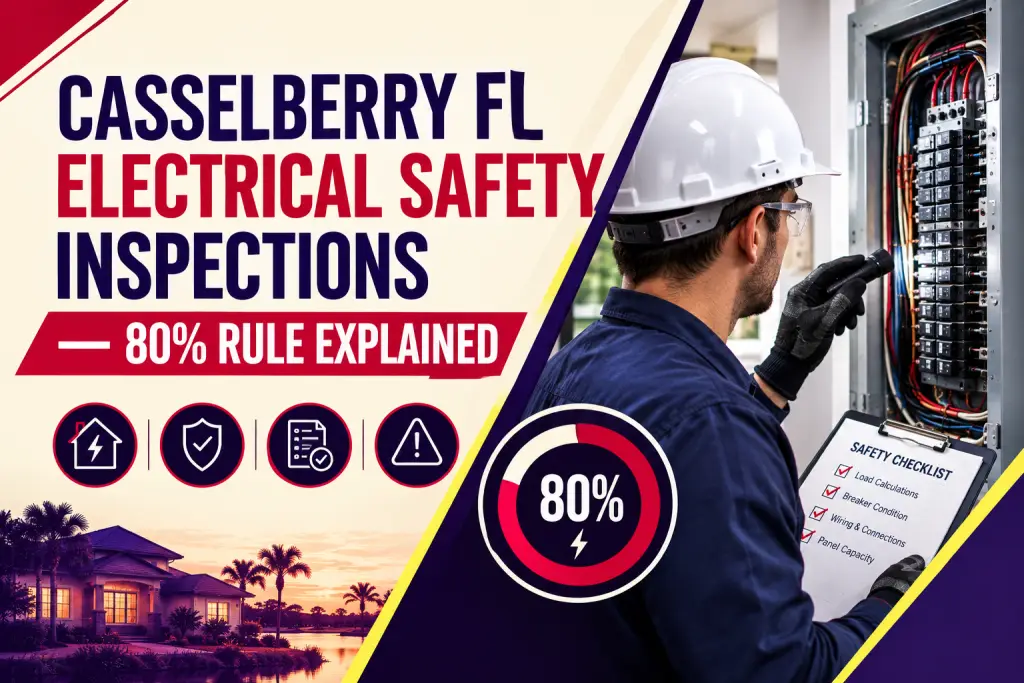
When an electrician evaluates your home’s breaker panel during a safety inspection in Casselberry, they don’t just check if wires are securely connected—they calculate how power actually flows through your system over time. One of the most critical standards used to prevent electrical overheating and unexplained breaker trips is the 80% Continuous Load Rule.
Understanding how this NEC (National Electrical Code) principle works helps Casselberry homeowners prevent thermal stress on panel components, protect major household appliances, and ensure long-term home safety.
What Is the 80% Continuous-Load Rule?
According to National Electrical Code guidelines, circuit breakers and conductors are rated for maximum electrical capacity under standard operating conditions. However, the rule distinguishes between two distinct types of electrical loads:
- Non-Continuous Load: An appliance or device that operates intermittently or stays on for short bursts (under 3 continuous hours), such as a toaster, hair dryer, garbage disposal, or microwave.
- Continuous Load: An electrical load where the maximum current is expected to run continuously for 3 hours or more.
The Core Rule: A standard overcurrent protection device (circuit breaker) should not be continuously loaded to more than 80% of its nominal rating.
For example, on a standard 20-amp circuit breaker:
- Maximum Peak Capacity: 20 Amps (2,400 Watts at 120V)
- Safe Continuous Operating Capacity (80%): 16 Amps (1,920 Watts at 120V)
If a continuous appliance draws 18 amps on that 20-amp breaker for over 3 hours, it violates the 80% continuous-load safety threshold—even though it technically remains below the 20-amp trip threshold on paper.
Common Continuous Loads in Casselberry Homes
In Central Florida, several high-power household devices run continuously for long periods, making them subject to continuous-load calculations:
- Central HVAC Systems: Air conditioning compressors and air handlers running back-to-back during hot Florida summer afternoons.
- Pool & Spa Filtration Pumps: Single-stage or variable-speed pumps scheduled to run 6 to 12 hours daily to maintain water clarity.
- Whole-Home Interior & Exterior Lighting: Recessed lighting banks or landscape floodlights left energized throughout the night.
- Electric Vehicle (EV) Chargers: Level 2 chargers drawing constant high amperage for 4 to 8 consecutive hours overnight.
- Electric Water Heaters: Water heating tanks operating during high-demand laundry or bath cycles.
Why Excessive Continuous Loading Causes Overheating
Circuit breakers do not trip instantly when current passes through them; they rely on internal bimetallic strips that flex in response to heat accumulation over time.
- Heat Accumulation: Operating a breaker near 100% capacity for hours generates steady ambient thermal buildup inside the panel enclosure.
- Nuisance Tripping: As heat accumulates inside the panel, the thermal trip mechanism becomes hypersensitive, causing the breaker to trip randomly even without an active short circuit.
- Terminal & Insulation Damage: Persistent high heat oxidizes wire terminals, loosens screw connections, and destabilizes the plastic insulation surrounding branch circuit wiring, creating potential arc fault hazards.
How an Electrical Inspection Identifies Load Violations
During a safety inspection in Casselberry, a licensed electrician performs load evaluation steps to catch 80% rule violations before components fail:
| Diagnostic Procedure | What the Electrician Checks |
| Infrared Thermal Imaging | Scanning the breaker panel under full operating load to detect hot spots, overheated terminal lugs, or overloaded individual breakers. |
| Amp-Clamp Meter Testing | Measuring real-time current draw across continuous branch circuits while HVAC units, pool pumps, and heavy appliances are engaged. |
| Panel Load Calculations | Summing total non-continuous and 125% continuous loads (the inverse calculation used by engineers) to verify total service panel capacity. |
| Wire & Breaker Matching | Verifying wire gauge adequacy (e.g., ensuring a 10-gauge conductor is paired correctly for heavy continuous loads like water heaters). |
Corrective Solutions for Overloaded Circuits
If an inspection reveals continuous-load violations, several straightforward remedies can restore safety and code compliance:
- Dedicated Branch Circuit Installation: Running a new, separate circuit for high-draw continuous appliances like pool pumps, window units, or EV chargers.
- Upgrading Breakers & Wire Gauges: Increasing conductor size and breaker ratings (e.g., upgrading a 15-amp circuit to a 20-amp circuit with 12 AWG wire) where supported by panel bus limits.
- Circuit Redistribution: Shifting connected lighting loads or outlet chains across less burdened panel slots to balance phase legs.
- Panel Capacity Upgrade: Upgrading an outdated 100-amp or 150-amp service to a modern 200-amp panel to accommodate expanding household continuous loads.
Protect Your System with A-Lumination Electric
Preventing continuous thermal overload is essential to extending the life of your appliances, breakers, and household wiring.
At A-Lumination Electric, our licensed master electricians specialize in thorough load calculations, thermal diagnostic scanning, and code-compliant panel upgrades across Casselberry and Seminole County. We identify hidden load imbalances and deliver clear, long-term solutions to keep your electrical system operating safely and efficiently.
Unsure if your home’s circuits meet continuous-load safety standards? Contact A-Lumination Electric today at (407) 298-1412 to schedule your comprehensive safety inspection! Or email photos to estimating@a-lumination.com for a Free Remote Quote.