
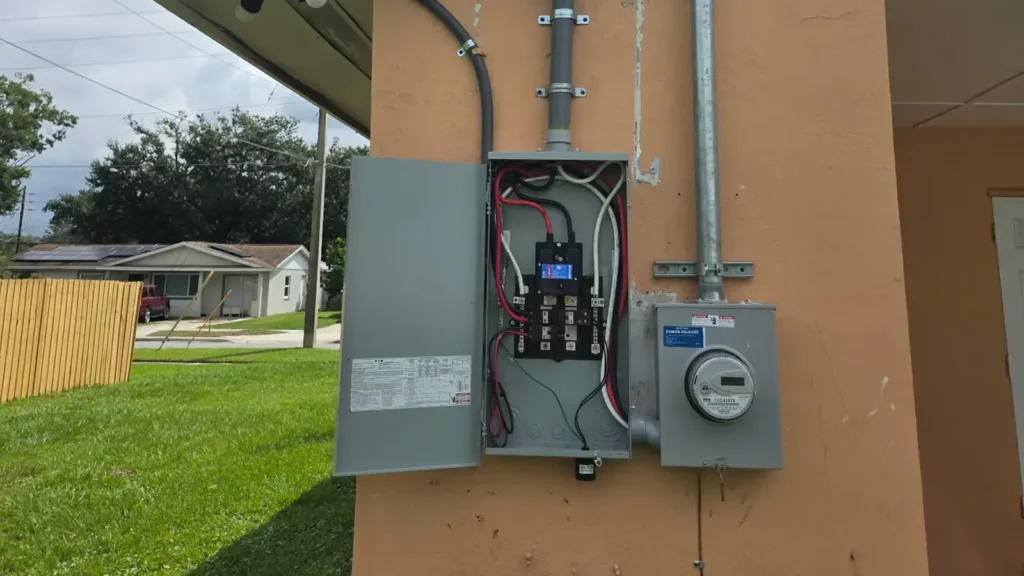
Safety first: If you smell burning or already see smoke coming from your panel, don’t open it. Get everyone out of the house, call the Fire Department, then call us once they say it’s safe.
The short answer: On the electrical section of a 4-point, the inspector records your panel’s type, size, age and brand. They also note any aluminum or cloth wiring and check off any of 13 listed hazards. If anything is checked as a hazard or marked “Unsatisfactory,” most carriers, and Citizens Property Insurance Corporation in particular, won’t write the policy until it’s fixed and documented. The fix is usually one targeted repair or a panel replacement, followed by a permit, an inspection and updated paperwork for your insurer.
If your agent just asked for a 4-point, or yours came back with the electrical section marked up, this guide walks through what the inspector looked at and what it takes to clear it.
What a 4-point is, and why Florida insurers ask for one
A 4-point inspection covers four systems: the roof, electrical, plumbing, and HVAC (heating, ventilation and air conditioning). Florida insurers commonly require one before writing or renewing a policy on an older home. It isn’t a home inspection. It answers one question: is this house insurable as it stands?
Most inspectors use the sample form from Citizens Property Insurance Corporation, Florida’s state-created insurer. The current version is Insp4pt 03 25, updated in March 2025. Citizens Property Insurance Corporation says the form “only is used to determine insurability and is not a warranty” of the systems. It accepts other reports if they “include at least this level of detail,” so this form is a good guide to any 4-point.
Two rules on the form matter once work gets done:
- A Florida-licensed professional must complete, sign and date it. Examples include a contractor, a building code inspector or a home inspector.
- A trade-specific licensed professional may sign off only on their own trade’s section. The form’s own example is an electrician signing the electrical section.
Which homes need a 4-point, and what each carrier accepts, varies by company. Your agent is the one to ask about your carrier’s rules.
The electrical section, line by line
Panel type and amps. The inspector checks “Circuit breaker” or “Fuse” and writes in the total amps, usually from the main breaker or the panel label. A second panel gets its own block.
“Is amperage sufficient for current usage?” A “No” has to be explained. The inspector weighs the service size against what the house runs today, such as central air, an electric range and water heater, a pool pump or an EV charger. A small service feeding a house that has grown around it is where this box gets a “No.”
Wiring present. The form asks about cloth wiring, active knob and tube, and branch-circuit aluminum wiring. There are also boxes for aluminum repaired with COPALUM crimps or AlumiConn connectors.
Hazards present. This is the block that decides most outcomes. There are 13 checkboxes: blowing fuses, tripping breakers, empty sockets, loose wiring, improper grounding, corrosion, over fusing, double taps, exposed wiring, unsafe wiring, improper breaker size, scorching, and other.
A few of these need translating:
- Double tap: two wires under a breaker terminal built for one.
- Empty sockets: in a fuse panel, a fuse holder with no fuse. In a breaker panel, inspectors usually apply it to an open slot in the cover with no filler plate, which leaves live parts exposed.
- Over fusing / improper breaker size: a fuse or breaker rated higher than the wire behind it can safely carry.
- Scorching: heat damage, such as darkened insulation, discolored breakers or melted plastic.
General condition. Satisfactory or Unsatisfactory. Unsatisfactory requires an explanation.
Supplemental information. This covers panel age, the year it was last updated, brand and model, and wiring type. The wiring types are copper, copper-clad aluminum, single-strand aluminum, multistrand aluminum, NM/BX/conduit, and two kinds of cloth wiring.
Photos. At minimum, the inspector needs the panel with its door label showing, the panel with the inner cover (the “dead front”) removed, and every hazard noted. Leave the dead front to the inspector or one of our technicians. Some parts behind it stay energized even with the main breaker off.
Citizens Property Insurance Corporation defines a passing system plainly: “each system is working as intended and there are no visible hazards or deficiencies.” Its note to agents says they “may not submit applications” for homes with electrical hazards or deficiencies. On an application to Citizens Property Insurance Corporation, a checked hazard box has to be fixed before the application can go in.
Quick reference: finding, fix and proof
- Double tap, wrong-size breaker, empty slot, loose or exposed wiring: usually fixed with a targeted repair at the panel. Your insurer will want a signed electrical section or a new 4-point.
- Scorching or corrosion in the panel: the damaged parts are replaced, often the whole panel. Your insurer will want the permit and final inspection, plus an updated form.
- Amperage “not sufficient”: a service upgrade, for example 100A to 200A. Your insurer will want the permit and final inspection, plus an updated form.
- Federal Pacific, Zinsco, Challenger or Pushmatic panel (if your carrier objects): panel replacement. Your insurer will want the permit and final inspection, plus an updated form.
- Single-strand aluminum branch wiring: COPALUM, AlumiConn, or rewiring with copper. Your insurer will want separate documentation certified by a licensed electrician. As your local licensed electrician, we can handle both the repair and the certification.
- Active knob and tube: the affected circuits are rewired. Your insurer will want the permit and final inspection, plus an updated form.
Panel brands that commonly get flagged
Four names come up again and again: Federal Pacific (FPE, “Stab-Lok” breakers), Zinsco / Sylvania-Zinsco, Challenger, and Pushmatic (also sold as Bulldog and ITE). All four were installed for decades and still turn up in older Central Florida homes.
The Citizens Property Insurance Corporation form doesn’t call any brand a hazard. It records brand and model, and each carrier decides what it accepts. The evidence also differs by brand. The U.S. Consumer Product Safety Commission closed its Federal Pacific investigation in 1983 without a recall. It found the available data didn’t establish a serious risk, while confirming that the breakers “fail certain UL calibration test requirements.” Concerns about the other three come mostly from electricians’ and inspectors’ field experience.
If your carrier wants one of these panels gone, the answer is replacement. No repair changes the brand on the label. Our electrical panel services page covers the rest of what we do with panels.
Aluminum and cloth wiring
Aluminum gets more lines on the form than anything else in the electrical section. The CPSC’s guide Repairing Aluminum Wiring (Publication 516) explains why. A mid-1960s copper shortage led builders to use aluminum on ordinary household circuits, and homes wired between 1965 and the mid-1970s may have it. The hazard is at the connections. A study done for the CPSC found pre-1972 aluminum-wired homes were “55 times more likely” to have a connection reach fire-hazard conditions than copper-wired homes.
The form separates single-strand aluminum, the solid wire feeding outlets, switches and lights, from multistrand aluminum, which is normal on service cables and large circuits like air conditioners and ranges. The single-strand kind is what triggers questions. The form requires “details of all remediation,” and since March 2025, that documentation “must be provided and certified by a licensed electrician.”
The CPSC recognizes only three permanent repairs: rewiring with copper, COPALUM crimps, and AlumiConn connectors. COPALUM requires a dedicated tool and die. All three are licensed-electrician work.
Cloth wiring is older wire with a fabric jacket, found in older houses and additions. Watch the word “active” on the knob-and-tube line. Abandoned, disconnected runs are a different finding from knob and tube that still carries power.
What a panel replacement brings with it today
A new panel isn’t just a swap. It’s built to the current Florida Building Code. That code adopts the 2020 National Electrical Code, which added two requirements for homes when the electrical service is replaced:
- Whole-home surge protection at the service.
- An outdoor emergency disconnect, so firefighters can cut power without entering the house.
The building department confirms exactly what applies, and we include it in the scope up front.
What a correction involves, step by step
- Permit. Panel replacements, service upgrades and rewiring need a permit from your county (Seminole, Orange or Osceola) or your city if it runs its own building department. We pull a permit on every job where code requires one.
- The work. A panel replacement means coordinating the disconnect and reconnect with your utility. Depending on where you live, that’s Duke Energy, FPL, OUC, Winter Park Electric or KUA. A single hazard like a double tap gets a smaller repair aimed at what the inspector found.
- Inspection. The building department inspects the work and closes the permit.
- Paperwork. Your carrier has to see the change in writing. That can be a new 4-point, or an electrician signing the electrical section. Aluminum remediation also needs the separate licensed-electrician certification. Ask your agent which option your carrier wants before work starts, so no effort is wasted.
A permitted, inspected job also answers the form’s question about updates: “the types of updates, dates completed and by whom.”
Already have a due date?
Most people who call us about a 4-point have a date coming up, such as a renewal, a new policy or a closing. We handle the permit, the inspection and the utility coordination for you. We apply for your permit right away and schedule the work as soon as the permit is issued, and we’ll tell you straight what has to be fixed now to clear the inspection and what fixes can wait.
Start with a Free Remote Quote, with no visit needed. Email your photos to estimating@a-lumination.com with your name, address and the best number to reach you. You can also text photos or information to our team at our main office line (407) 298-1412.
Include:
- The panel label (inside the panel door), showing brand and model
- The panel with its door open so the breakers show. Open the door only, and leave the inner cover on.
- The electric meter and meter base
- The electrical page of your inspection report, if you have it
Our estimating team will review them and get back to you with next steps.
Panel work is often unbudgeted. We offer financing through Synchrony.
Questions we hear
Can my panel’s brand alone cause a problem? The form doesn’t list any brand as a hazard, but carriers set their own rules. Ask your agent where yours stands.
Can an electrician fill out the 4-point? An electrician can sign the electrical section. The rest needs a licensed contractor, building code inspector or home inspector.
Is 100-amp service an automatic fail? No. The form has no minimum. It asks whether the amperage is “sufficient for current usage,” so the answer depends on what your house runs. If you’re planning to add load, our post on 100A to 200A service upgrades covers that decision.
Do I have to rewire aluminum to pass? Not necessarily. The form expects COPALUM or AlumiConn remediation with licensed-electrician documentation. Whether your carrier accepts that or wants copper is a question for your agent.
Should I open my panel before the inspector comes? Open the door to read the label if you like. Leave the inner cover alone.
Talk to us before the due date gets close
A-Lumination Electric is a licensed and insured Florida electrical contractor serving Seminole, Orange and North Osceola counties since 1989. We replace older panels, including Federal Pacific and Zinsco, and handle 4-point electrical corrections.
Call or text (407) 298-1412, or email photos of your panel to estimating@a-lumination.com for a Free Remote Quote.